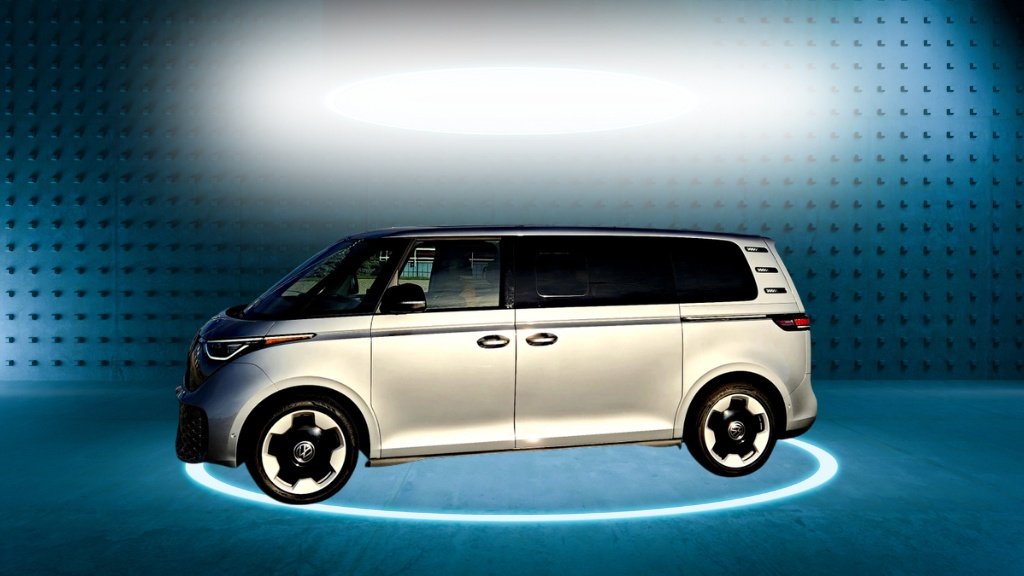
The 2025 Volkswagen ID. Buzz arrived with massive hype, promising a modern revival of the iconic 1960s Microbus. Ever since VW began teasing its electric redesign, nostalgia kicked in hard—fans expected a fun, free-spirited, tech-packed EV that could recreate the spirit of the original Bus.
But after a full test and real-world evaluation, one thing becomes clear: the new ID. Buzz isn’t exactly what many expected. In fact, it feels more like a quirky, expensive minivan than a retro revolution.
A Modern Throwback… Mostly on the Outside
Visually, Volkswagen absolutely nailed the retro appeal. The short overhangs, boxy-but-rounded silhouette, and stubby front end instantly recall the Microbus of the ’60s and ’70s.
But unlike the old flat-faced Type 2—which had almost no safety features—the ID. Buzz includes a proper hood, crumple zones, and modern driver-assistance tech.
However, beyond the styling, the resemblance fades quickly.
Interior: Scandinavian Minimalism With Odd Ergonomics
Step inside the ID. Buzz and you’re greeted with what looks like a carefully curated Scandinavian Airbnb—clean lines, minimal controls, soft colors, and lots of empty space.
Everything initially seems purposeful, but that impression dissolves after some time behind the wheel. The interior has several puzzling design choices:
- Storage spots positioned where no human hand naturally reaches
- A third row that feels like sitting on a wooden crate
- An infotainment system that’s confusing until you get used to it
- Features placed without regard for today’s minivan standards
Volkswagen clearly didn’t consult competitors like Chrysler, Toyota, or Kia, who have spent decades perfecting family-vehicle ergonomics.
Yet, in a strange way, some quirks are charming. The long, sharply raked windshield and deep dashboard give the driver a unique cockpit-like view. The head-up display appears visually far ahead of the vehicle—almost two car lengths—which is odd but surprisingly helpful once accustomed to.
Performance: Way More Power Than the Original, but Limited Range
Where the ID. Buzz truly improves over its ancestor is power. The original 1.6-liter air-cooled engine barely made it up hills. The 2025 electric Buzz?
It delivers 335 hp (246 kW)—nearly seven times more power.
Buyers can choose between:
- Rear-motor model, or
- Dual-motor AWD version (recommended for better power distribution)
Acceleration is respectable—quicker than the average modern family vehicle, though nowhere near performance EVs like the Tesla Plaid. It feels closer to a Nissan Leaf in delivery, which actually fits its mission.
Range Issues Remain
VW claims around 230 miles (370 km), but real-world driving—especially at highway speeds—will likely deliver under 200 miles.
The tall, boxy shape that gives the ID. Buzz its charm unfortunately works against aerodynamics.
Third Row: Improved, but Still Not Ideal
Interestingly, Volkswagen originally designed the third row not to fold down. That decision has since been reversed, but the seats remain hard and uncomfortable, especially for long road trips.
For a vehicle marketed as a family EV, comfort should have been a priority.
So Who Is the ID. Buzz Really For?
At its core, the 2025 Volkswagen ID. Buzz is about nostalgia, uniqueness, and style. It stands out on the road, gets attention everywhere it goes, and scratches that retro itch for Microbus fans.
But underneath the charm, it’s still a minivan—an expensive one.
The base model starts at US$62,000, and if you want the iconic two-tone paint scheme? Expect the price to climb noticeably higher.