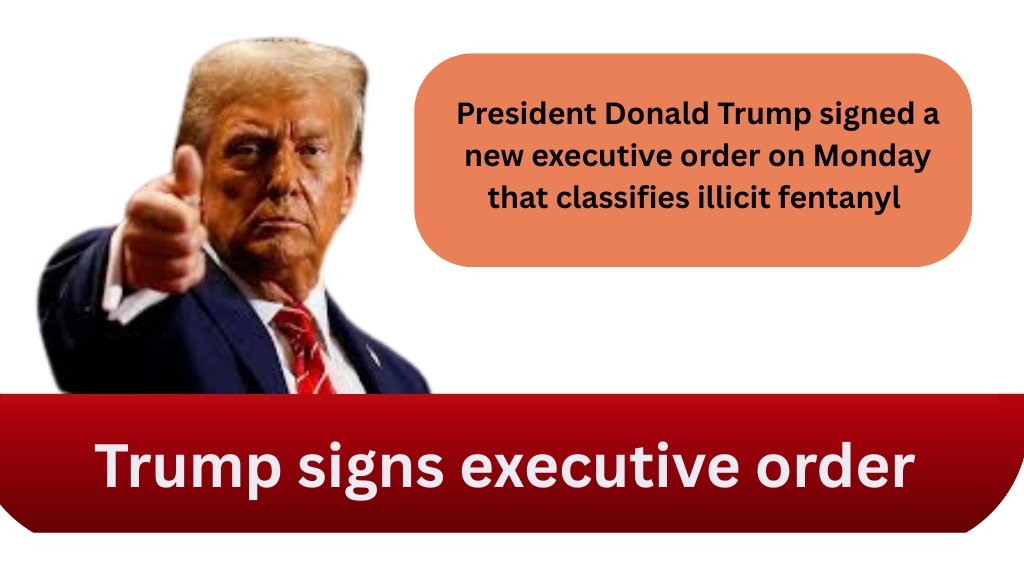
President Donald Trump signed a new executive order on Monday that classifies illicit fentanyl and its core precursor chemicals as weapons of mass destruction, marking a dramatic escalation in the administration’s rhetoric surrounding the ongoing opioid crisis. The move, announced from the Oval Office, immediately sparked debate over its legal impact and practical consequences.
Standing alongside U.S. service members being honored for their role in border security, Trump described the order as a historic step aimed at protecting Americans from what he called the devastating effects of fentanyl entering the country. He argued that the drug’s impact rivals that of conventional weapons, stating that no bomb causes the level of destruction fentanyl has inflicted on American communities.
What the Executive Order Does—and What It Doesn’t
The executive order formally frames illicit fentanyl as a national security threat, asserting that it more closely resembles a chemical weapon than a traditional narcotic. It directs Attorney General Pam Bondi to immediately pursue investigations and prosecutions related to fentanyl trafficking, while also instructing Secretary of State Marco Rubio and Treasury Secretary Scott Bessent to take appropriate actions against financial assets and institutions linked to the manufacture and distribution of the drug.
However, the order does not change existing federal law. Under current U.S. statutes, the use, attempted use, or threat of use of a weapon of mass destruction is already a serious crime that can carry the death penalty under certain circumstances. Federal law also includes weapons involving biological agents or toxins within its definition of weapons of mass destruction.
Because presidents cannot alter statutory law through executive orders, legal experts have questioned whether the designation will materially affect prosecutions or enforcement strategies.
Legal Experts Question Practical Impact
Former federal prosecutor Dennis Fitzpatrick, who previously handled national security cases in the Eastern District of Virginia, described the order as largely symbolic. He argued that existing drug trafficking statutes are already well established, effective, and familiar to law enforcement agencies and prosecutors.
According to Fitzpatrick, labeling fentanyl as a weapon of mass destruction could actually complicate enforcement efforts rather than strengthen them. He suggested that such a significant legal shift should be addressed by Congress, not implemented through executive action, calling the move an example of political messaging rather than substantive policy change.
Fentanyl Framed as a National Security Threat
The executive order goes beyond criminal justice framing by casting fentanyl trafficking as a direct threat to U.S. national security. It claims that foreign terrorist organizations and international cartels profit from fentanyl production and distribution, using those funds to support assassinations, insurgencies, and terrorist activities worldwide. According to the order, these operations undermine both domestic security and public health.
The administration has repeatedly emphasized the role of international drug networks in fueling the fentanyl crisis, particularly along the southern border.
Contrasting Context: Overdose Deaths Decline
The announcement comes at a time when new federal estimates indicate a significant drop in drug overdose deaths across the United States. Data released in May shows overdose fatalities fell to their lowest level in five years last year. Despite the overall decline, synthetic opioids—primarily fentanyl—remain involved in the majority of overdose deaths nationwide.
Border Security and Military Recognition
The signing ceremony also highlighted the administration’s emphasis on border enforcement. Defense Secretary Pete Hegseth announced the revival of the Mexican Border Service medals, originally authorized by Congress in 1918. He said the medals honor service members tasked with defending U.S. sovereignty, drawing parallels between current deployments and those from more than a century ago.
A Move Likely to Fuel Political and Legal Debate
While the executive order underscores the administration’s aggressive stance against fentanyl trafficking, its real-world implications remain uncertain. Critics argue that without congressional action, the designation may have limited legal effect, while supporters view it as a strong symbolic message about the severity of the crisis.
As fentanyl continues to dominate national conversations around public health, border security, and law enforcement, Trump’s latest move is expected to intensify debate over how far executive power can—and should—go in confronting the opioid epidemic.